Stripping away maritime terminology reveals a basic mechanical reality onboard any sea-going vessel: not all horsepower serves the same purpose. A vessel can feature megawatt-class powertrain blocks in its hull, yet remain dead in the water if the wrong engine type powers its thrusters, winches, or electrical grids.
Selecting between a marine propulsion engine and a marine auxiliary engine isn’t just about output power. It determines how force is transmitted, how loads are absorbed, and how reliable a vessel stays in open water.
The Core Operational Distinction
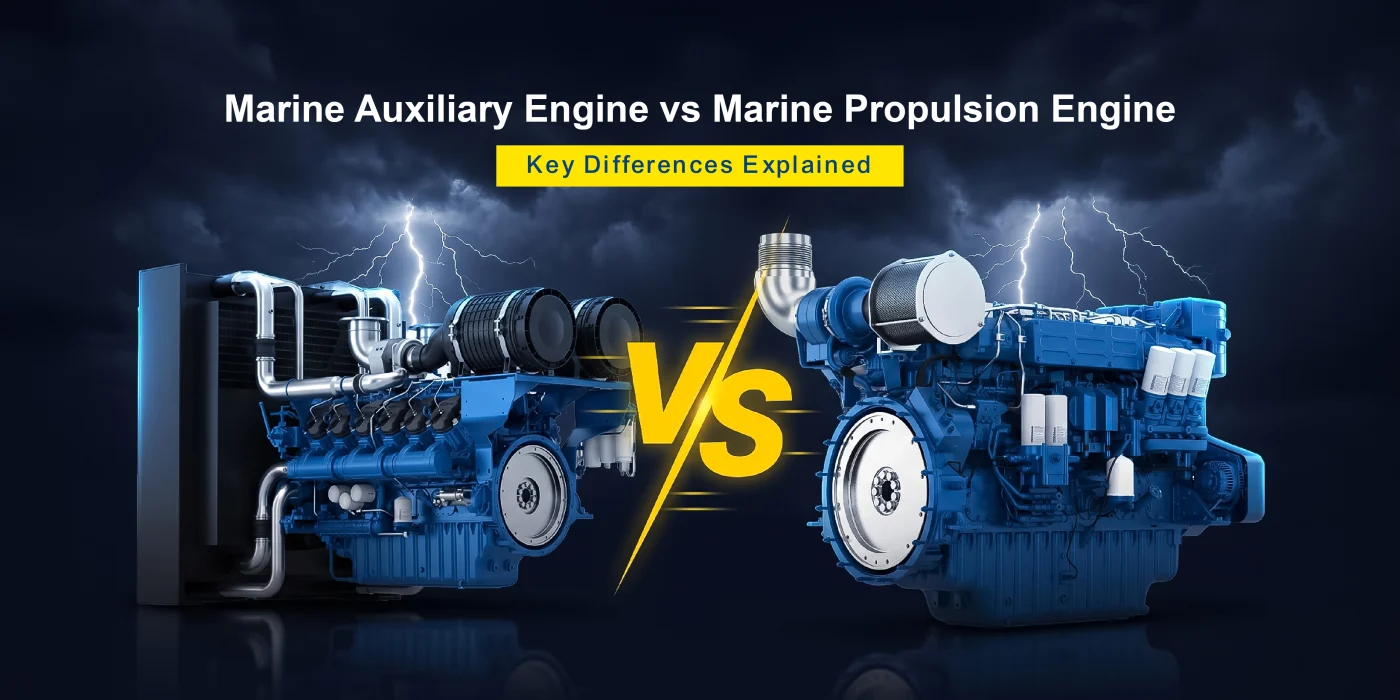
The fundamental difference lies in work delivery: propulsion engines push the ship through water, while auxiliary engines power onboard systems.
- Marine Propulsion Engine: Connects directly to the shaftline, gearbox, or waterjet to drive the propeller. It operates under variable speed and torque profiles dictated by weather, hull resistance, and speed demands.
- Marine Auxiliary Engine: Drives electrical generators (gensets), hydraulic pumps, fire pumps, or air compressors. It runs primarily at a constant governor-controlled speed to maintain steady voltage and frequency.
Technical Comparison: Propulsion vs. Auxiliary
While both engine types share core marine diesel engine design principles, their internal calibration and output delivery differ significantly.
| Engineering Parameter | Marine Propulsion Engine | Marine Auxiliary Engine |
| Primary Duty | Direct mechanical propulsion | Electrical power generation & hydraulic drive |
| Speed Profile | Variable speed across operating curve | Constant governed speed (e.g., 1500 RPM @ 50 Hz / 1800 RPM @ 60 Hz) |
| Load Characteristics | Follows propeller demand curve (P ∝ N3) | Variable electrical step-load acceptance |
| Duty Ratings | Continuous (Unrestricted), Heavy Duty, Intermittent | Continuous Prime (PRP), Emergency Backup |
| Regulatory Focus | IMO Tier II / Tier III emissions, EEDI speed optimisation | IMO Tier II / Tier III emissions, ISO 8528 load governance |
Mechanical and Structural Variations
1. Governor & Fuel Control Systems
Auxiliary units require fast-acting electronic governors to handle sudden electrical step-loads without frequency drops. If a heavy cargo crane engages, the auxiliary governor must adjust fuel injection in milliseconds. Propulsion engines use multi-point maps that balance fuel economy against variable sea resistance.
2. Cooling Systems and Heat Exchangers
Propulsion engines reject heat into raw seawater cooling circuits calibrated for wide speed variations. Auxiliary engines, especially emergency generator setups, rely on radiator systems or dedicated central cooling channels to maintain steady thermal bounds during continuous station-keeping.
3. Classification and Safety Certification
Both engine types require marine classification certification (such as BV, ABS, or DNV). However, auxiliary emergency engines must feature independent dual-starting systems (electric, hydraulic, or pneumatic) to guarantee immediate startup during total power loss.
Key Considerations for Vessel Owners & Shipbuilders
- Match Duty Cycles to Operational Reality: Specifying a light-duty propulsion engine for continuous commercial towing leads to early thermal fatigue and premature overhauls.
- Prioritise System Standardisation: Sourcing propulsion and auxiliary blocks from the same engine platform simplifies spare parts inventory and streamlines crew maintenance protocols.
- Evaluate Fuel Efficiency Curves: Propulsion engines require peak efficiency across a wide RPM band, whereas auxiliary engines must optimise fuel burn at fixed 1500 RPM or 1800 RPM operational points.
Powering Marine Performance with Baudouin India
Specifying marine power systems demands proven engineering durability and strict regulatory compliance. Marine operators require prime movers designed to withstand continuous exposure to saltwater environments and heavy operational demands.
As one of the trusted diesel engine manufacturers in India, Baudouin India provides comprehensive marine power packages backed by a century of European maritime heritage. Built for commercial fishing vessels, tugs, passenger ferries, and inland cargo ships, Baudouin’s heavy-duty marine diesel engine lineup spans both propulsion and auxiliary configurations.
Featuring robust mechanical design, high thermal efficiency, and simplified onboard serviceability, every marine propulsion engine and marine auxiliary engine package built by Baudouin, a marine diesel engine manufacturer, delivers reliable performance across demanding sea routes.